Wind electricity can be converted into synthetic liquid fuel — diesel, gasoline or kerosene — from air and water via electrolysis and Fischer–Tropsch synthesis. These calculators estimate the electricity cost per litre/gallon of fuel, and how much fuel a single Carter Model 300 turbine can make per year, including the atmospheric CO₂ drawn in and O₂ released. Ported from steveclamp.com.
⚠ Estimate Only — Not for Contractual Use
These calculators provide planning-level estimates only, generated from modelled wind resource and indicative electricity prices. The power-company / business contract figures are screening proxies, not contracted tariffs. Results carry no warranty as to accuracy and must not be relied upon for a binding contract, financing, procurement, or final design decision. Actual yield depends on site-specific wind measurement, turbulence, air density, array losses, grid terms, and local regulation. For a precise, site-specific analysis, contact Carter Wind Solutions.
Wind only. This calculator covers Carter wind turbine output and the wind contractor price. Solar pricing is handled separately and is not part of this tool.
Opens a printable, light-background report of the active calculator — choose “Save as PDF”.
Inputs
Electricity Price
Currency
Volume Unit
Process Efficiency 45%
Calculated Results
Electricity Cost per Litre
Fuel Volume Produced per kWh
Basis & Assumptions
Fuel energy content uses lower heating value (LHV): diesel 9.94, gasoline/petrol 8.89, kerosene/Jet A 9.48 kWh/L. Electricity required per unit = LHV ÷ process efficiency. US gallon = 3.78541 L. Figures show the electricity component only — capital, CO₂ capture and operating costs are excluded. Source equations adapted from www.fuelfromair.com.
Inputs
Avg Wind Speed (m/s)
Turbine Purchase Price
Currency
Volume Unit
Capital Payback (yrs)
Process Efficiency 45%
Turbine Energy Capture
Annual Fuel Produced per Turbine
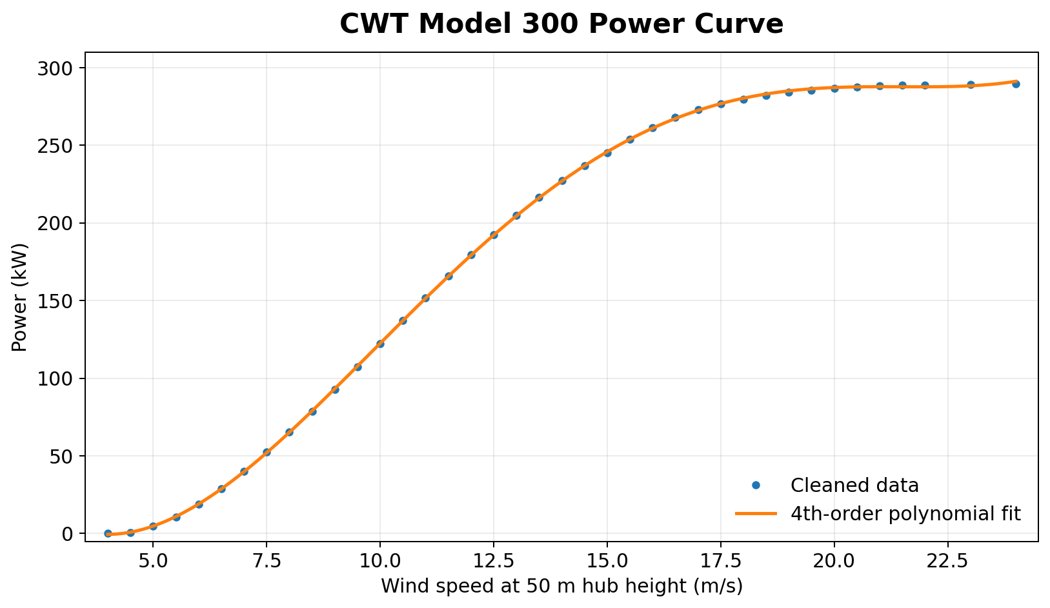
CWT Model 300 Power Curve
Annual Fuel Volume per Turbine
Capital + Maintenance Cost per L — 10 Year Profile
Analysis
Basis & Assumptions
Power output follows a 4th-order fit to the CWT Model 300 power curve (cut-in 4 m/s, rated ≈290 kW, cut-out 24 m/s). Annual energy integrates the curve against a Rayleigh wind distribution over 8,760 h/yr. Fuel uses the same LHV figures and efficiency as the estimate tab. CO₂ absorbed and O₂ released follow synthesis stoichiometry (≈2.3–2.6 kg CO₂ in, ≈2.6–2.8 kg O₂ out per litre); carbon is re-emitted on combustion, so the cycle is carbon-neutral. Cost = capital recovered over the payback years + 5% annual maintenance. Indicative engineering estimate only. Source equations adapted from www.fuelfromair.com.
Inputs
Location
Site Wind Speed
Turbine Purchase Price
Currency
Volume Unit
Consumer Price (kWh) value of wind power/yr
Wind Contractor Price (kWh) power-company contract income
Capital Payback (yrs)
Process Efficiency 45%
Turbine Energy Capture
Annual Fuel Produced per Turbine
Wind Rose — Directional Frequency
CWT Model 300 Power Curve
Annual Fuel Volume per Turbine
Capital + Maintenance Cost per L — 10 Year Profile
Analysis
Basis & Assumptions
Power output follows a 4th-order fit to the CWT Model 300 power curve (cut-in 4 m/s, rated ≈290 kW, cut-out 24 m/s). Annual energy integrates the curve against a Rayleigh wind distribution over 8,760 h/yr. Fuel uses the same LHV figures and efficiency as the estimate tab. CO₂ absorbed and O₂ released follow synthesis stoichiometry (≈2.3–2.6 kg CO₂ in, ≈2.6–2.8 kg O₂ out per litre); carbon is re-emitted on combustion, so the cycle is carbon-neutral. Cost = capital recovered over the payback years + 5% annual maintenance. Indicative engineering estimate only. Source equations adapted from www.fuelfromair.com.
Inputs
Average Wind Speed
Wind Speed Unit
Revenue per kWh
Currency
Turbine Purchase Price
Payback Years (target)
Annual Output & Yield
Power & Revenue Across Wind Speeds
Operating Point On The Power Curve
CWT Model 300 — Verified Power Curve
Power Curve Data
Basis & Assumptions
Annual energy uses the verified CWT Model 300 power curve (cut-in 4 m/s, rated ~290 kW, cut-out 24 m/s) weighted over a Rayleigh wind-speed distribution about your stated annual average — the standard estimating method, since instantaneous gusts contribute disproportionately to energy. 8,760 operating hours/year with a 5% maintenance/availability allowance. Money yield = annual kWh × revenue per kWh. Wind speed converts at 1 m/s = 2.23694 mph. Indicative engineering estimate; site turbulence, air density and array losses are excluded.
Inputs
Location
Site Wind Speed
Wind Contract Price (kWh) power-company / income
Consumer Price (kWh) retail value of wind power
Currency
Turbine Purchase Price
Payback Years (target)
Annual Output & Yield
Power & Revenue Across Wind Speeds
Operating Point On The Power Curve
CWT Model 300 — Verified Power Curve
Power Curve Data
Basis & Assumptions
Annual energy uses the verified CWT Model 300 power curve (cut-in 4 m/s, rated ~290 kW, cut-out 24 m/s) weighted over a Rayleigh wind-speed distribution about your stated annual average — the standard estimating method, since instantaneous gusts contribute disproportionately to energy. 8,760 operating hours/year with a 5% maintenance/availability allowance. Money yield = annual kWh × revenue per kWh. Site mean wind speed is the indicative annual average for the selected region (mid-point of the published range). Indicative engineering estimate; site turbulence, air density and array losses are excluded.
Where It Works
Built For The Field
The 300 kW Carter turbine is sized for distributed, on-site generation where reliability and easy maintenance matter most.
Agriculture & Farms
On-site power for irrigation, dairy, and farm operations, set in the open acreage these machines were made for.
Remote & Off-Grid
Crane-free service makes the turbine ideal for sites far from heavy lifting infrastructure and roads.
Community Energy
A right-sized 300 kW machine for community-scale and cooperative renewable projects.
Industrial & Commercial
Behind-the-meter generation that trims demand charges for facilities with good wind resource.
Telecom & Infrastructure
Dependable distributed power for critical sites where uptime and serviceability are essential.
Grid-Edge Support
Local generation that strengthens weak grid endpoints and reduces transmission losses.